


WORKSHOPS AND TRAINING

Training and workshops delivered onsite or virtually to teams or organisations, with the option to include follow-up coaching and mentoring
practical application
Our whole approach is designed around making critical thinking skills real world compatible - both in terms of facts about people and how they think and operate, and also in terms of the context that they think in. (See here) The skills and strategies we teach people are chosen for having maximum reach and designed to work in real world situations, in real time. (See pedagogy)
DISCOVER WHAT IT REALLY MEANS TO THINK CRITICALLY AND ANALYTICALLY and how to apply to complex, real-world contexts (? - or ghost?)
THINK WELL ALONGSIDE AI ensure AI enhances and doesn't inhibit your thinking / SHARE YOUR THINKING BETTER WITH BOTH PEOPLE AND AI/ more judicious use of AI
UNDERSTAND BETTER/ KNOWLEDGE NOT JUST OF HOW TO INFLUENCE OTHERS BUT ALSO BE INFUENCED - READ CRITICALLY ETC
GREATER CONFIDENCE AND STRENGH OF OWN JUDGMENT
Entry Level 'Emergency Surgeries'
Our unique programme in applied critical and analytical thinking takes you through everything you need to know about high level thinking skills; how to apply to everyday contexts; and how to connect to other aspects of our thinking such as our ability to think creatively and to shaer our thinking effectively with others.
FUll course
Our unique programme in applied critical and analytical thinking takes you through everything you need to know about high level thinking skills; how to apply to everyday contexts; and how to connect to other aspects of our thinking such as our ability to think creatively and to shaer our thinking effectively with others.
From general, 'Emergency Surgeries' in critical thinking suitable for all; to our full course in Applied Critical Thinking, our stimulating and engaging workshops will help you to swfifly assess informaiton, make stronger judgments and decisions, and communicate your thinking more effectively with the world.

(This list perhaps better on the training page)
the difference between evidence and examples
why you need to combine reasons and emotions when sharing thinking (what thst means and how to do it)
why dividing things into fact or opinion mostly doesn't work, and what to do instead
why to be distrustful of stpries...
how to recognise and test different types of claim
whena and how much to trust intuition
how to move from creative to critical mindsets
How we achieve them
(examples of) The knowledge I teach you
facts about how we process information, how a lot of our thinking is unconscious, and about the role of emotion
rules about reasons and evidence and how they work (e.g. the difference between evidence and examples)
rules about different kinds of claims, how to recognise them, and how to treat them
how to test intuition; when and how much to trust our gut
how to move from a critical to a creative mindset
please note these are just examples: for a fuller account of what you learn go to trainings
(examples of) What this enables you to DO (better)
distinguish between good and bad reasons
draw better, more insightful conclusions from data and information
pressure-test thinking: test claims, ideas, theories, proposals, strategies
be more perceptive about cases of not knowing
frame your ideas so they land better
anticipate and respond to objections
Note about how I/ we prefer to think of them as knowledge, not skills (?)
(Or make that point on the training page)
What does it mean to be a wiser, more self-aware thinker?
It may sound a bit pompous, and also a bit nebulous or vague, but actually it is neither of these things.
All it really means/ entails is:
understanding the role of emotions in our thinking
understanding how a lot of our thinking is unconscious (and how and where conscious thinking slides into unconscious)
being more perceptive about cases of not knowing
THe first two are about being more self-aware/ what we mean by being more self-aware
As for the third, Socrates famously came to accept the oracle's declaration that he was the wisest person in the whole of Athens by realising that he was the only person who at least knew that he didn't know anything! Simply be recognising and being more perecptive about cases of not knowing can make you wiser
What it means in practice:
recgnising/ being able to recognise claims that stop short of knowledge and being able to distinguish between them - recommendations, predicrtions, explanations, theories, ...
being sensitive to/ ensuring you work on both reasons and feelings when sharing thinking; thinking about what is at stake fo r the other person and how the suggestions may e.g. be a threat...
having a healthy, respectful scepticism - and also curiosity
The other goals are fairly obvious and self-explanatory (NB partly why chosen them). This one perhaps deserves a bit more attention - what it means, how it fits into the others, how we achieve it
Relationship between main goals and wider one
While we use our three main goals to focus what we do
How it's more a consequence of what we learn to achieve these ends - if you are making better choices about the info coming in and being more reflective about what you put back out; if you are more understanding about how you and others process and receive information, etc, then you are by definition becoming a wiser, more self-aware thinker.
But at the same time, it's also necessary to achieve these ends. You can't think more critically/ effectively/ discerniningly about these things without having learnt these facts/ limitations about our thinking, etc...
I DON'T TEACH SKILLS. I TEACH KNOWLEDGE. I SHARE THE KNOWLEDGE I HAVE GAINED FROM A CAREER TEACHING AND ASSESSING CRITICAL THINKING, AND THAT I USE IN EVERYDAY LIFE TO JUDGE BETWEEN CLAIMS, DECIDE WHAT TO PAY ATTENTION TO - AND TO WHAT EXTENT
Joe Chislett, KRITIKOS Founder
Select from our entry-level 'Emergency Surgeries', or our full course in Applied Critical Thinking
[any of these remaining sections if not sure if want then just dump for now in a hidden page]
Entry Level 'Emergency Surgeries'
Our unique programme in applied critical and analytical thinking takes you through everything you need to know about high level thinking skills; how to apply to everyday contexts; and how to connect to other aspects of our thinking such as our ability to think creatively and to shaer our thinking effectively with others.
Our provision
FUll course
Our unique programme in applied critical and analytical thinking takes you through everything you need to know about high level thinking skills; how to apply to everyday contexts; and how to connect to other aspects of our thinking such as our ability to think creatively and to shaer our thinking effectively with others.
From general, 'Emergency Surgeries' in critical thinking suitable for all; to our full course in Applied Critical Thinking, our stimulating and engaging workshops will help you to swfifly assess informaiton, make stronger judgments and decisions, and communicate your thinking more effectively with the world.
Other benefits/ virtues
UNDERSTAND BETTER WHWN YOU DON'T KNOW; USE TO BE MORE CURIOUS, OPEN-MINDED YET DECISIVE, CONFIDENT YET HUMBLE, RESPECTFUL SCEPTICISM
better convos/ interactions/ working (and other) relationships
Wiser thinking, better judgments

Wiser thinking, better judgments


(this bit to go after the Full Course before ES?)
REAL WORLD THINKING REQUIRES MORE THAN JUST BEING ABLE TO THINK CLEARLY, CRITICALLY AND ANALYTICALLY - YOU NEED TO BE ABLE TO SHARE YOUR THINKING, AND, WHERE NECESSARY, ACT ON IT!
Joe Chislett, Founder KRITIKOS
Full course: Applied Critical and Analytical Thinking
Full course = 6-8 hours
Can be split into intermediate and advanced (3-4 hours each)
Swiftly yet wisely assess the quality of information - decide what to pay attention to and how much
Know what makes a good or bad reason - about what to believe or do, and distinguish between them
Wisdom: Recognise when and why things stop short of being knowledge - and what else is needed to ...
Communicate your thinking more effectively - frame your thinking so it lands better with others
Combine critical and creative thining... - frame your thinking so it lands better with others
what we cover
what you learn
You learn how to
-
Quickly analyse information and assess its signifiance
-
Test ideas, claims, arguments, theories and models
-
Pressure-test thinking to reveal blindspots and assumptions
-
Judge evidence: the difference between evidence and examples; the power and also limitations of evidence - the role of principles and values especally in decision-making
-
Assess the role of analogies, stories and metaphors
-
Identify potential strengths and weaknesses in arguments, claims, evidence and ideas; be able to test these more formally and effectively
SHARING THINKING:
How our thinking evolved to be shared/ a social thing and works better in this environment; however, can be done well or less well...
- how a lot of our thinking is unconscious and the impliocations for thinking mongst others
- the emotional as well as the rational dimension to thinking and to sharing thinking; how to combine successfully so that ideas connect and resonate
- psychological and sociological issues and challenges around updating (why it's important to us to be seen to be right, why we don't like to admit when we are wrong) and how to mitigate these
- the importance of sharing thinking, the value of but also the problems with dealing with pushback
- issues and problems around agreement and disagreement: avoid groupthink and escalation into binary, "fight or flight" threat states
- how to be more sensitive to contextual factors, other perspectives, and the unknown
ANALYSEING AND EVALUATING WHAT COMES IN:
How our thinking evolved to be shared/ a social thing and works better in this environment; however, can be done well or less well...
-quickly assess credibilily beyond simple common sense/ how to hone predictions/ forecasts
- identify different kinds of claims and why they stop short of being knowledge
-
PRESSURE-TESTING OUR OWN THINKING: EVALUATING WHAT COMES OUT:
How our thinking evolved to be shared/ a social thing and works better in this environment; however, can be done well or less well...
- how a lot of our thinking is unconscious and the impliocations for thinking mongst others
- the emotional as well as the rational dimension to thinking and to sharing thinking; how to combine successfully so that ideas connect and resonate
- psychological and sociological issues and challenges around updating (why it's important to us to be seen to be right, why we don't like to admit when we are wrong) and how to mitigate these
- the importance of sharing thinking, the value of but also the problems with dealing with pushback
- issues and problems around agreement and disagreement: avoid groupthink and escalation into binary, "fight or flight" threat states
- how to be more sensitive to contextual factors, other perspectives, and the unknown
how to quickly assess credibilily beyond simple common sense/ how to hone predictions/ forecasts
Link thinking to action: frame your thinking so it lands better with others
COMBINING CRITICAL AND CREATIVE THINKING
This workshop takes a deeper dive into the relationship between critical and creative thinking. Why they both need each other and how to get them working in harmony.
-
Exploit the natural human tendency to generate thoughts and ideas
-
Enter 'play' mode; ways to encourage idea generation
-
Switch the two sides on and off, when and how to move from more consciously effortful to more free-form instinctive thinking
LINKING THINKING TO ACTION
Exploit the natural human tendency to generate thoughts and ideas
-
Handle uncertainty
-
Avoid over-thinking by knowing when and how much to think and having the confidence to go with your judgment
-
Know when to trust in faster and more instinctive forms of thinking such as instinct or intuition or simple common sense
Session 1:
Session 2:
Session 3:
Session 4:
Session 5:
Session 6:
Introduction to critical and analytical thinking: identifying claims, inferences and assumptions
Beyond fact and opinion: a matter of judgment
Approaching uncertainty: trust, credibility, likelihood
Common pitfalls and how to avoid: cognitive fluency, confusing evidence with examples
Sharing thinking part 1:
Sharing thinking part 2:
Session 7:
Session 8:
Session 9:
Session 10:
Session 11:
Session 12:
(Getting more advanecd) Drawing and evaluating conclusions
Evidence & its limits: values, principles, and suppositional thinking
Pressure-testing thinking to reveal hidden assumptions
Sharing thinking part 3: anticipating and responding to objections
Combining critical and creative thinking
Summary and application: Linking thinking to action:

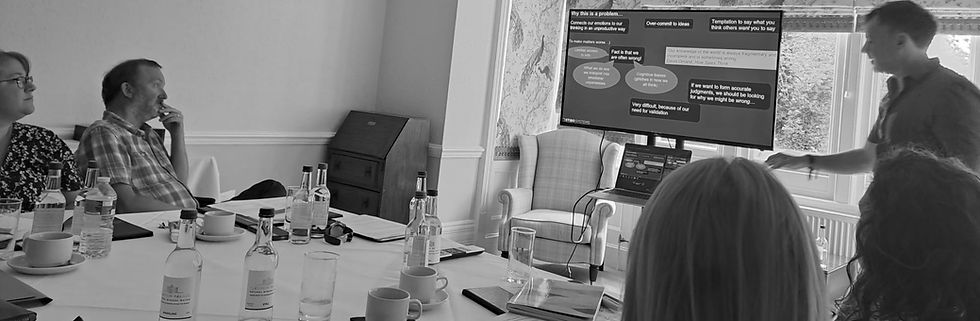
'Emergency surgery' workshop (2 hours): protect and enhance your critical thinking skills. Why a lot of critical thinking advice is unhelpful. What you can really do to improve your thinking - simple principles made clear and accessible, applied to real world contexts.
EMERGENCY CRITICAL THINKING SURGERIES
There is a double crisis in critical thinking right now. Not only is there an urgent need to promote critical thinking, but much of the support and advice is unhelpful - and even misleading. Our emergency workshops look at the common misconceptions around critical thinking and how to correct for these. We show you why advice such as "don't jump to conclusions", "question your assumptions" or "analyse the information before making a decision" is at best unhelpful, and at worst actively misleading.
Drawn from 20 years experience writing and designing thinking skills tests, as well as having co-authored books on critical thinking, we replace the unhelpful advice and common misconceptions with strategies that are actually useful; such as:
-
What actually IS good evidence? What's the difference between evidence and examples?
-
How do you actually reveal assumptions in your thinking? Which are the ones I should question?
-
What constitutes a jump to a conclusion?
-
How to test claims and inferences
Our simple strategies, largely jargon-free, show you how you can incorporate critical thinking into your work and life, in ways that make sense and that are not confusing!
"Thanks again for your energy and openness — it made the experience really enjoyable!"
Joanna

Let our stimulating and engaging workshops sharpen and strengthen the most important resource you possess: the collective intelligence of your workforce.
I FOUND THE SESSION VERY POWERFUL. IT HAS LEFT ME A LOT TO GO AND REFLECT ON!
Nick, Senior Leadership Team, Waingels College
teaching approach and pedagogy
teaching background
avoid cognitive load
practical application
_edited.jpg)
Joe is an experienced teacher and teaching coach; he spent 17 years teaching 16-19 year olds so he knows how to keep lessons interactive and engaging!
Joe is careful to avoid the use of unnecessary technical terminology. The aim after all is to bring clarity to people's thinking, not further clutter. He only selects the ideas that have the most cognitive fluency, and that are the most directly effective in terms of developing the four skill areas above
The focus throughout is on real world application. Ideas are applied to real world situations and contexts; delegates learn by doing, and discussing - and solving - problems together.
Who we help
Individuals
Tailored training and/ or coaching/ mentoring. Help individuals to maximise their thinking, giving them greater autonomy and agency. Develop strength and confidence in their judgment, the confidence to evaluate and propose ideas
Teams and organisations
Group training to improve team alignment; the sharing of ideas. Maximise the most important asset of any team or organisation: the collective intelligence of its workforce
Career progression and leadership
The need to make judgments and decisions is the hardest challenge of entering leadership or management roles. The skills we develop give you strength and confidence in your own judgment: the flexibility to act on your thinking but listen and adapt where necessary